

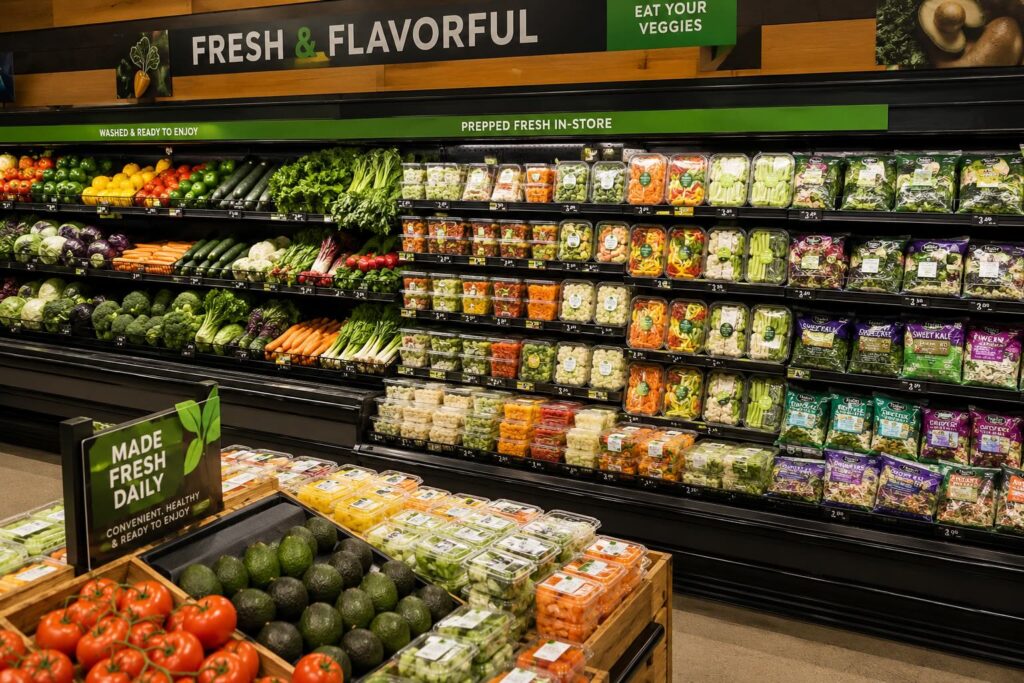
FDA’s new guidance on RTE fresh-cut produce closely reflects the food safety best practice recommendations that TAG has long been making for these products.
The Guidance on Minimizing Biological Hazards in RTE Fresh-Cut Produce applies to fresh fruits and vegetables with water activity above 0.85 that have been physically altered from their whole state without additional processing prior to distribution, with recommendations focused on the control of potential biological hazards. While the guidance covers many topics, there is focus on the recommendation to include sanitizers in produce wash water. The guidance includes in-depth discussion on how to implement appropriate sanitization of produce wash water as a process preventive control. Important to note, the goal of sanitizer in produce wash water is to prevent cross contamination– not to provide appreciable inactivation of pathogenic bacteria adhered to the surface of produce. As such, the guidance outlines a few viable strategies that facilities can undertake to ensure their wash water process is meeting that goal, in the form of validation.
Wash water validation is required under 21 CFR 117.60 for both single-pass and recirculated processes, but that does not mean that all facilities need to perform experiments to validate their systems. Validation can include reference to scientific literature, previous validation studies, and mathematical modeling, provided it adequately reflects your operating system. Validations may also be comprised of scientifically valid experimental data, including data collected during operating conditions.
Should a company want to complete their own validation studies, the guidance outlines parameters that may be included, with explicit examples using two common sanitizer chemicals: sodium hypochlorite and peroxyacetic acid. Examples include both fixed parameters such as flume flow rate for large operations, water temperature (i.e., 34oF-36oF), and variables to test during validation (e.g., sanitizer concentration, pH, and organic load for chlorine-based sanitizers). Validation will determine the critical limits for parameters that can be variable in the system.
Because the guidance is intended for larger producers who use recirculated water flumes, sanitizer dwell time is not mentioned. So, if your flume is six foot or smaller, or you are using batch water, TAG recommends that you consider sanitizer contact time (dwell time) as a possible parameter in validation studies.
It is important to note that you are not required to validate all of your SKUs, rather you should choose the one that most challenges your system (as determined by scientific literature, expert consultation, risk assessment, etc.). You could consider the amount of organic load coming in, the product that poses the highest risk of foodborne illness, the product you process the most, or a combination of these in selecting the product to validate.
Some additional notes on validation include:
- You can use a surrogate to complete your validation study, but if you choose to do so, you must include justification as to how they adequately represent the bacterial hazard you are trying to control (i.e. Enterococcus faecium for Salmonella).
- Finding your critical limits for concentrations of an antimicrobial can be completed by performing your own validation study, leveraging appropriate scientific or technical information, or a combination of these.
- If referencing scientific literature, you can choose the scope of your study to determine if your system, operating at worst-case scenario (i.e., fastest feed rate, smallest cut size), can consistently ensure that the sanitizer concentration in the wash water (measured at the point in the flume where the concentration is lowest) is above the critical limit outlined in the scientific literature.
- You can also conduct your own experiments in pilot plants or laboratories to determine the minimum concentration of sanitizer, among other critical limits of parameters, that would prevent cross contamination of bacteria from one product to another through the water.
- Additional validation preparatory experiments may need to be conducted to determine when the maximum organic load is reached (to inform critical parameters and water change schedules); the point in the system where sanitizer concentration is lowest (i.e., to inform continuous monitoring sensor placement or sampling points for manual monitoring); and the minimum frequency for manual parameter monitoring.
- Ensure that you have well-written, easily understood documentation that explains your validation study—including the goals of the study, experimental design, the analysis used, the data, and conclusions.
- Ensure that the operating limits of all sanitizer chemicals follow applicable regulations (i.e., 21 CFR 173.315).
- It is also important to outline your monitoring, verification (i.e., instrument calibration), and corrective actions. Note that in this process, if critical limits are not met rewashing produce is not an effective corrective action, as sanitizer in the wash water is not intended to provide appreciable kill to microbes on the surface of produce.
- The guidance includes sample preventive control summary tables in the appendix, which can be very helpful.
In addition to the wash water validation, the guidance also provides recommendations on equipment and food contact surface sanitation frequencies, sanitation verification (which may include considering both Listeria and Salmonella), cut-product temperature requirements, GMPs, worker training, supply chain programs, etc. For example, with finished products that will be consumed without a kill step likely needing a supply chain preventive control on the source farm, the guidance outlines appropriate verification activities that include on-site audits and reviews of a supplier’s relevant food safety records and regulatory history.
Overall, TAG sees the guidance as helpful to ensuring the food safety of fresh-cut produce, however we would offer some additional recommendations as well.
- We recommend that, when conducting your validation, you work with a scientific expert to ensure experiments are designed such that valid data are gathered, and enough samples are tested to provide the statistical strength to accurately identify critical limits.
- While it is a baseline expectation that growers be audited through a GFSI-recognized scheme or be on a maturation journey of their programs to achieve that, TAG does not recommend that a supplier be accepted based only on a passed audit, as there can be a great deal of variation in auditors and scoring.
- Understanding that some facilities do not buy directly from a farm but from a distributor, TAG highly recommends that these facilities work with their distributor to gain visibility into the supply chain program and determine its adequacy; obtain primary records from the source farm for evaluation; or conduct their own audit or inspection of the farm, if possible.
With the guidance identifying many practices that TAG has been recommending its clients include in their food safety management practices for fresh-cut produce, we have the experience and expertise to assist in your validation, supply chain management, and general food safety efforts – both to fulfill this new guidance and to take your food safety to the next level. Give us a call to help! In summary, FDA’s new guidance on RTE fresh-cut produce closely reflects the food safety best practice recommendations that TAG has long been making for these products. While the guidance covers many topics such as equipment and food contact surface sanitation frequencies, sanitation verification, cut-product temperature requirements, GMPs, worker training, and supply chain programs, much of it focuses on how to implement appropriate sanitization of produce wash water as a process preventive control. Overall, TAG sees the guidance as helpful to ensuring the food safety of fresh-cut produce, however we would offer some additional recommendations as well.