


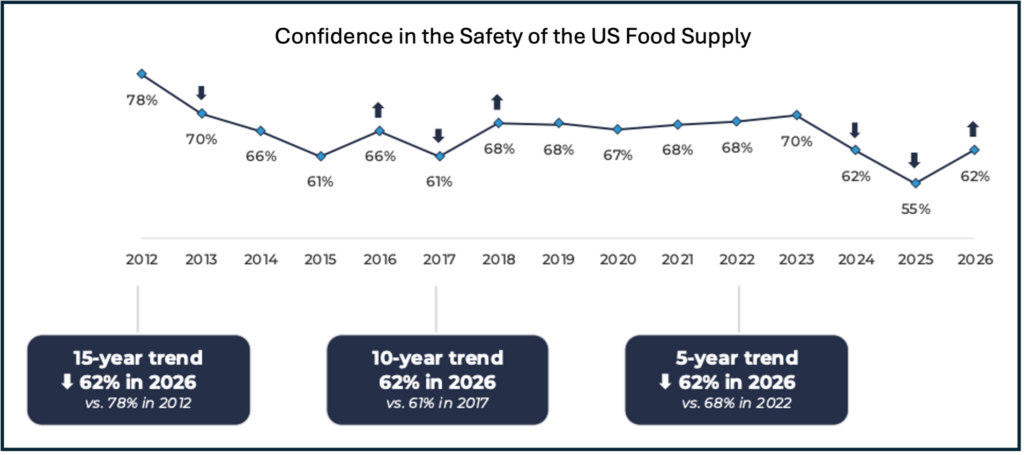
Although consumer confidence in the safety of the US food supply increased from 55% to 62% over the past year, the five-year trend still shows a decrease in confidence since the 68% confidence of 2022. The annual IFIC Food & Health Survey, taken in the spring, also shows that 2026 confidence is significantly lower than the 15-year trend that held a high of 78% in 2012, and the increase was from the record-low 55%. Additionally, because the survey was taken in the spring before this summer’s outbreaks, it may be somewhat misleading as to the current state of consumer confidence. So IFIC also conducted a follow-up survey in August, which we cover later in this article.
While the 2025 to 2026 increase matches the survey’s largest year-over-year gain, with 2025 hitting an all-time low, the increase still ranks 2026 as having one of the lowest confidence rates in the last 15 years.
The survey analysis shows the top five food safety concerns of 2026 remaining the same as those of 2025; however, the order has changed:
- In 2025, foodborne illness was considered to be the top food safety issue overall (50% ranked it in their top three), with carcinogens second (47%); pesticides and residues (46%); heavy metals (41%); and food additives/ingredients rounding out the top five with 36% ranking it as a top issue.
- The 2026 survey showed pesticides ranking first among Americans’ top food safety issues (48%), followed by carcinogens (46%), with foodborne illness dropping to third (43%). Heavy metals came in at fourth (40%) and food additives/ingredients fifth (37%)
When comparing domestic and imported foods, a slightly higher percent of respondents felt that domestically produced foods were safer than imported, with 32% deeming imported food as less safe and 30% deeming both as equal in safety; only 12% felt that imported foods were safer than those produced or grown in the US.
Given all this, what did respondents say could help to increase their confidence in the safety of the US food supply? As a general rule, the responses focused on transparency, with the top responses being understanding how food companies (42%) and the government (41%) ensure that food is safe, and wanting stricter regulations around food safety (41%).
Post-Cyclospora Outbreak Survey
Due to the extent of the lettuce Cyclospora outbreak, IFIC also conducted a second survey in August focused on awareness of and response to the outbreak, but did not assess overall confidence in the food supply.
With 86% of those surveyed being aware of the outbreak, 65% actively followed the news. As a result, many changed their eating habits, with 30% avoiding consumption of any lettuce, 29% avoiding iceberg lettuce, and 22% avoiding or reducing consumption of any produce overall.
Survey respondents were also asked under what conditions would they eat lettuce, which elicited the following responses – some of which are certainly of concern.
76% If it is grown locally
72% If the FDA confirms that all affected lettuce has been identified and removed from the market
71% If it is grown in the U.S.
68% If it is washed thoroughly
67% If the CDC announces that the lettuce-related illness outbreak is over
62% If my friends or family are eating lettuce
59% If it is available for sale at my regular grocery store
59% If it is served at a restaurant I trust
These responses show that consumer education is vital, particularly related to the 68% who said they would feel comfortable eating lettuce if it were washed thoroughly. As stated by CDC, washing alone cannot guarantee Cyclospora removal, as the parasites are resistant to standard chlorine-based sanitizers. Friend and family consumption of a recalled product is also not a sign of safety, rather it is frequently those who have eaten the same food that all become ill. And, although the most recent outbreak implicated lettuce grown in Mexico, there have been a number of outbreaks originating in the US. So, while the US does have stringent programs to help ensure safety, trusting all produce just because it was grown in the US is not necessarily a sign of safety.
Rather, the best way for consumers to stay safe is to remain actively aware of recalls and outbreaks and ensure you are properly handling all foods in your home. For the food industry, regularly reeducating workers on food safety basics and ensuring that they are actively applying them is the best way to keep consumers safe – and increase their confidence in the US food supply.
In summary, according to the annual IFIC Food & Health Survey, conducted this past spring, consumer confidence in the safety of the US food supply increased this past year, however the five-year trend still shows a decline since 2022. The survey showed foodborne illness to be the top food safety concern. The IFIC conducted a second survey in August to learn about consumer views following the Cyclospora outbreaks. This survey found that consumer education on food safety, as it relates to Cyclospora, is low.