


On August 10, President Trump signed an Executive Order realigning the US core childhood vaccine recommendations citing a January 2026 HHS assessment comparing the American immunization schedule to those of other countries. Those recommendations focus on three immunization categories:
- All children should receive measles, mumps, rubella, diphtheria, tetanus, pertussis, polio, Haemophilus influenzae type B, pneumococcal disease, human papillomavirus, and varicella.
- Certain high-risk groups or populations should receive respiratory syncytial virus monoclonal antibodies, hepatitis A, hepatitis B, meningococcal B, meningococcal ACWY, and dengue.
- Shared clinical decision-making should be considered for hepatitis A, hepatitis B, rotavirus, meningococcal disease, influenza, and COVID-19.
The order also recommends that the measles, mumps, rubella (MMR) vaccine be administered in three separate single-disease shots (once available) and all childhood immunizations be administered at separate medical visits, when feasible. Both the order and the assessment on which it is based are generating controversy, as there is not only no evidence to support the recommendations, but spacing out the immunizations recommended for all children would require that multiple, separate vaccination visits be made within the first year of a child’s life.
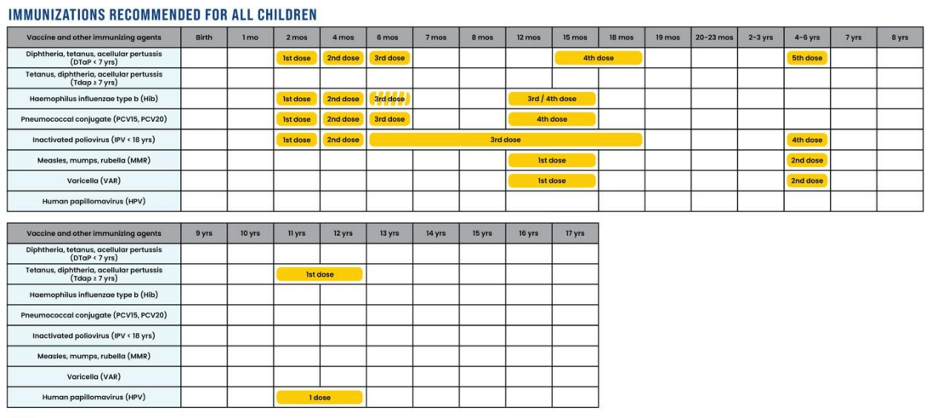
Additionally, the extended timeframe for vaccination could lead to missed doses and/or a child’s contracting a disease prior to being inoculated – particularly with the current continued spread of measles.
Within two days of the Order being signed, a Federal Register notice was also published seeking nominations for membership on the National Vaccine Advisory Committee (NVAC), a federal advisory committee within the HHS. While NVAC was established to provide advice and make recommendations to the National Vaccine Program director, its functions are solely advisory. Additionally, the notice states that the nomination process can take many months, so the committee is unlikely to have any impact on the childhood immunization schedule any time in the near future.
It also is unlikely that the executive order would take effect, as a president does not have the authority to rewrite statutory vaccine schedules, or override state school vaccine laws, through an executive order. In fact, prior attempts have faced court blocks and state lawsuits, as Congressional and CDC action is required for such changes. As noted by the American Academy of Pediatrics, “Delaying or skipping shots is risky, especially as measles continues to spread and children go back to school,” thus the order is likely to further the confusion and doubt of the importance of childhood vaccines.
COVID Risk Matrix (As of July 29, 2026)
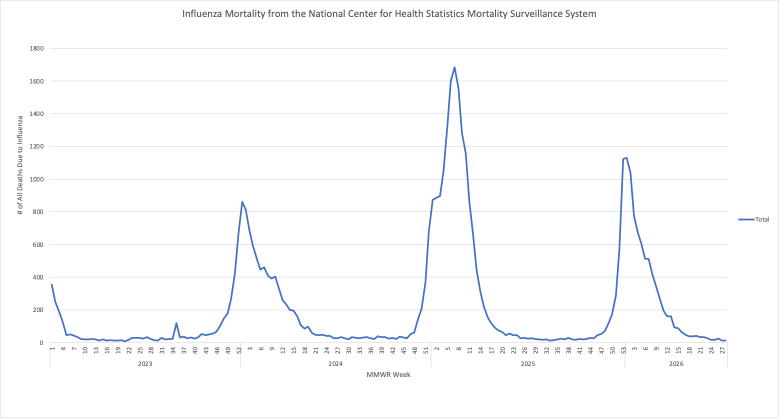
Influenza (As of July 29, 2026)
Public Health News
- The Ebola outbreak in the DRC has now killed more people than the 2018-20 outbreak, which killed 2,299 individuals. The current outbreak is not identified as the deadliest Ebola outbreak ever in the DRC with 2,325 deaths. The largest Ebola outbreak ever recorded was a 2014-26 outbreak in West Africa, which killed 11,325 over two years.
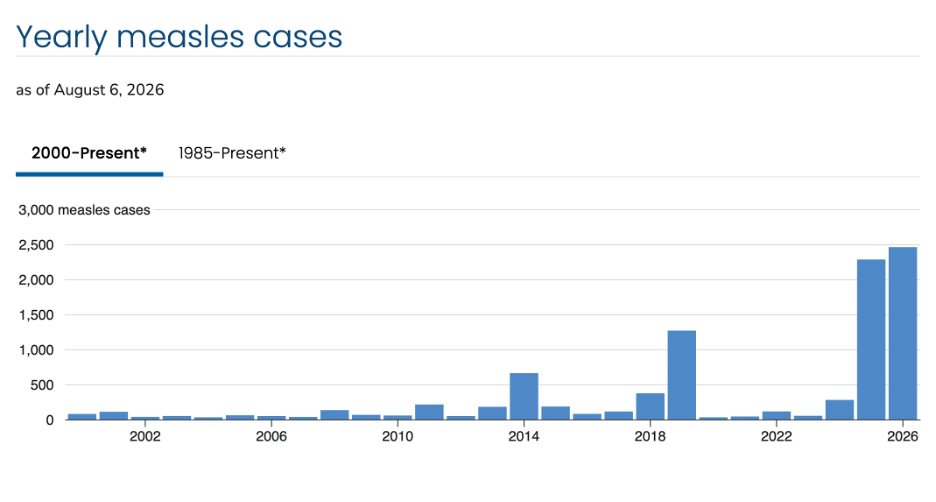
- 101 cases of measles were confirmed nationwide last week. The total as of August 14 is 2,566 cases. This was the second week in a row of about 100 new cases after previous weeks’ totals of about half of that. Most of the recent cases were in Pennsylvania, though Ohio also saw a notable increase.
- Florida has recorded its second death from Vibrio vulnificus. This year Florida has recorded 14 cases. Last year the state reported 33 cases and 15 deaths.
- Toronto Public Health is currently investigating legionnaires’ disease outbreak near downtown core. The outbreak has six confirmed cases spans in about a one-kilometer radius of the intersection of Bathurst and Dupont streets. Officials have said cases do involve individuals who live, work or have visited the area and they developed symptoms between July 2 and July 26. This could be linked to a previous outbreak of a long-term care home in the area.