

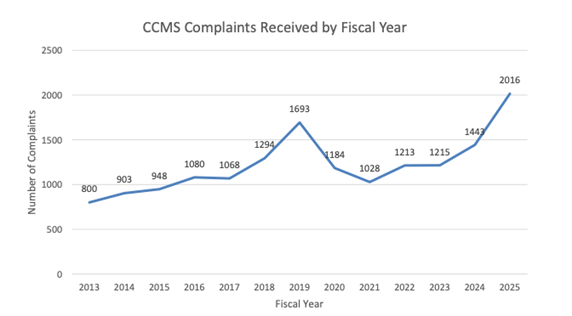
USDA FSIS consumer complaints have been on a steady increase, with the more than 2,000 consumer complaints in FY 2025 being the highest number since the 2001 establishment of the FSIS Consumer Complaint Monitoring System (CCMS).
Of the 2,016 consumer complaints received by FSIS, 1,961 were directly related to meat, poultry, or egg products, with the most frequent complaint related to foreign objects in the food, which made up more than a third (36%) of all the complaints. In addition to these, the CCMS logged suspected foodborne illness, quality issues (i.e., products that look, smell, or taste different than expected), and mislabeled product concerns as the next most common.
When FSIS receives a consumer complaint, case managers review the information provided, then follow up with consumers to gather more information. They also review other CCMS data for related complaints that may signal a broader problem, examine FSIS inspection records if a source facility is identified, and evaluate the severity and potential public health risk.
The investigations of the 2025 complaints led to 85 voluntary actions by establishments (i.e., reassessing HACCP plans, retraining employees, and implementing new equipment); 17 administrative or enforcement actions by FSIS; and five product control actions which included four recalls (two for foreign objects and two for product sold without inspection) and the destruction of uninspected product at a retail establishment.
With the 2025 spike in number of complaints, we could very likely see government action taken, as there was after the previous spike in 2019. At that time, the primary issue was also foreign materials, so FSIS issued the FSIS Guideline for Industry Response to Customer Complaints 2020 to inform industry of the procedures the agency identified as best practices for responding to customer complaints and preventing similar occurrences. Though published primarily for foreign material issues, it can be applied to any customer complaint – and the advice still applies today.
While the Guideline is not a regulatory document, it “recommends” that establishments develop a customer complaint program, to include criteria and mechanisms for determining if the products were produced at that establishment; if the complaint is genuine and authentic; and if any tampering occurred after shipment from the producing establishment.
As such, a customer complaint program should include the following components (discussed in further detail in the guideline):
- Reporting. Regardless of the source, each customer complaint should be evaluated as a possible report of adulterated or misbranded products in commerce, with methods developed for consumer and commercial complaint reporting and the receiving and processing of these.
- Substantiation. Criteria and mechanisms for review of complaints should be developed to verify production location and ensure proper notification. Criteria should also determine if tampering occurred after shipment and substantiate the evidence, if any, of adulteration/misbranding. Household complaints should be substantiated as quickly as possible to remove adulterated products from commerce, especially if there is a food safety hazard; and, if substantiated, FSIS must be notified per 9 CFR 418.2.
- Response Plan and Investigation. If it is determined that an adulterated or misbranded product entered commerce, an investigation should be performed to determine corrective actions. Best practice is to draft and maintain a written response plan to include: investigation of the production, including records review; a visual inspection of any questionable products or labels; observation of ongoing production of like products; and discussion with applicable employees. Because some complaints result in a recall, you may want to include a complaint response plan in your recall plan.
- Documentation. Best practice is to document all customer complaints (substantiated or not), the investigative steps performed, how the claim was or was not substantiated, how FSIS was notified, how the establishment identified all implicated products and support for the determination, what corrective actions were performed, and the results of a HACCP reassessment, if performed.
- Regulatory Requirements. Although the customer complaint program is not a regulatory requirement, certain actions may be required if there is a finding of adulterated or misbranded products. That is, the establishment must prevent further products from entering commerce, remove any products that have entered commerce, and notify FSIS as required by 9 CFR 418.2. Additionally, as required by HACCP regulations, corrective actions must be made when a food safety hazard occurs.
While the resolution of customer complaints is critical, just as important are the learnings that come from that resolution and the application of those to improving the establishment’s food safety processes and programs – and to reducing complaints. Like finished product testing, customer complaints, in and of themselves, are not a preventive control. But by ascertaining the source of a failed test or customer complaint, a facility can make corrections and turn the failure into an achievement by incorporating the learnings into its food safety programs and preventive controls.
Should you need any assistance with managing customer complaints or developing a program, give TAG a call. We have USDA experts who can help!