

The Acheson Group
Disease Fact Sheets
Cyclosporiasis Fact Sheet
What is Cyclosporiasis?
Cyclospora is a parasite whose only host is humans. It has a tough outer coat which makes it very resistant to typical mitigation strategies. An infected person sheds the parasite in oocyte form in feces, which then needs to mature in an environment with temperatures of 72-90°F for up to 2 weeks before it can infect other humans who consume them. Thus, outbreaks occur primarily in summer months. Given the biology of the parasite, person-to-person spread is unlikely. Typically, contamination from infected feces occurs through contact with water, which means that irrigated produce could be at risk. A paper, published in 2020, described more than three dozen outbreaks in fresh produce since 1995.
Why Should I Care about Cyclosporiasis?
- Cyclospora is resistant to standard sanitizers.
- Washing produce will not remove contaminating oocysts to any significant degree.
- Cyclosporiasis cases may be missed as Cyclospora is not part of the standard gastrointestinal screening tests.
- It can take as long as two weeks after exposure for symptoms to appear, making traceback to a suspect food or water source difficult.
- Without treatment, symptoms can persist for weeks
- Symptoms may go away and then come back during the infection.
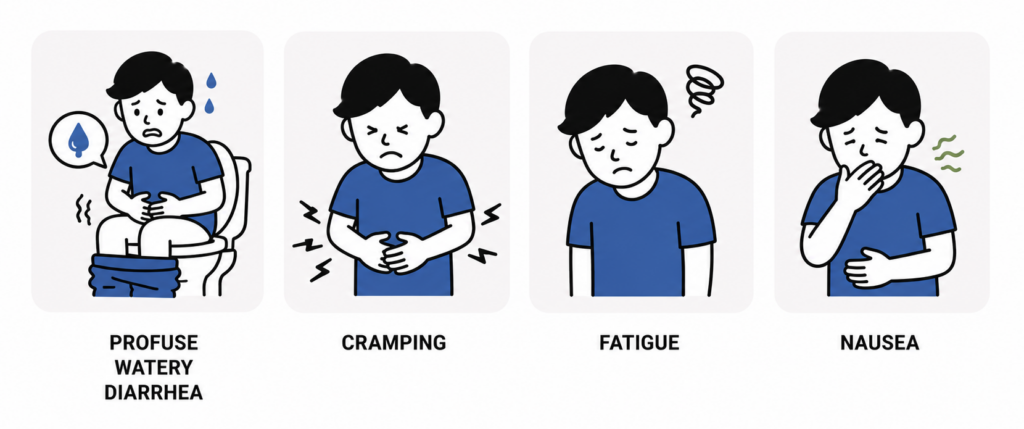
SIGNS & SYMPTOMS OF CYCLOSPORIASIS
What Do I Do About Cyclosporiasis?
- Verify that produce field workers have access to adequate field sanitation – including properly stocked and appropriately located toilet and handwashing stations, documented hygiene training, sanitary disposal of toilet paper – and that employees are following these protocols.
- Ensure that employees do not work when ill.
- Cooking foods to 158°F or freezing at -4°F for two days can inactivate Cyclospora oocysts.
- Seek medical care if Cyclospora is suspected. Prescription sulfa drugs can be used to effectively treat Cyclosporiasis.
TAG Public Health Experts have the experience and expertise to help companies and institutions successfully integrate science-driven public health approaches into their business strategy.