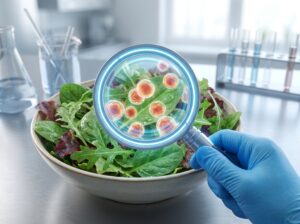

Safe food is always the ultimate goal, but is zero risk actually achievable?
To better discuss this, let’s start with an example of a simple apple. An apple carries inherent hazards: its seeds can be poisonous, it could cause choking, or its skin may be grimy and bacteria-ridden. So, does that mean no one should eat apples, and regulations banning apples should be enacted?
If one lives simply by avoiding all hazards, the answer has to be yes. Hazards exist everywhere, so that thinking would exclude nearly every food from one’s diet, and every action from one’s life.
But a hazard is not a risk. Rather, risk is determined by hazard x exposure. So, if we look at the apple again: the seeds are poisonous only if eaten in high numbers; chewing well will generally alleviate the potential of choking; and thoroughly washing the apple will take away the grime. Thus, taking a few minor control measures to reduce the exposure/the potential of harm significantly reduces the risk. But the risk is still not, and cannot be, zero.
It is exactly why the FDA has focused on “closer to zero” vs. absolute zero with a goal to reduce dietary exposure to contaminants, such as heavy metals like lead, to as low as possible, while maintaining access to affordable, nutritious foods. It is why hazard should not be confused with risk, and why risk assessments need to focus on the balance of benefit vs risk rather than reducing the risk to zero.
To delve further, let’s look at a recent Cornell study discussing the difference between hazard and risk and why an expectation of zero risk “may be pushing edible food into the trash, driving up costs with limited public health benefits, and causing other consequences that can negatively impact the environment and human health.”
If one were focused only on the hazard, the very detection of a pathogen – regardless of level or potential risk – would be a sound basis for regulation. But as we’ve discussed, focusing on the hazard is not a valid assessment of risk, even though it has been used as an argument for overly stringent rules. An example of this is the regulation defining any ready-to-eat (RTE) food that tests positive for Listeria monocytogenes (Lm) as adulterated, regardless of level or whether it would support the growth of Listeria. As the study’s lead author, Martin Wiedemann, stated, “Just as we don’t limit highway speeds to 10 miles per hour to minimize deaths, we need to take a balanced approach that considers possible negative consequences of extreme food safety measures.”
The value of risk-based approaches to food safety is generally well-recognized and broadly supported, not only in the U.S. (as specifically seen by the name of the primary rule of FSMA: Current Good Manufacturing Practice, Hazard Analysis, and Risk-Based Preventive Controls for Human Food), but also around the world, as exemplified by the WHO 2022–2030 Global Strategy for Food Safety which recommends “When setting and implementing regulatory requirements, the national food control systems should consider the whole food chain and take a risk-based approach.”
As the ability to detect presence (of pathogens, pesticides, heavy metals, etc.) gets ever lower, the risk-based approach becomes increasingly important. Not only do micro levels not necessarily present a risk, but the ability to detect can become greater than the ability to prevent or control. Thus, a regulation requiring the recall of a product if any level is detected can mean the disposal of food that would not, in actuality, present a risk – particularly when there has been a high amount of the product in commerce that has a low probability or risk and has not caused any documented illnesses.
With the greater focus on chemical risks, there is a danger that even more food will be deemed adulterated when low levels of chemicals are found in that food. Consumer pressure to reduce any hazard even closer to zero has the potential to drive up waste and drive up costs with little to no public health gain.
Not only are such hazard-based restrictions causing the disposal of edible foods, the time and effort needed for the recall, disposal, and often unfeasible corrective action can divert resources from higher risk issues. Further, with the speed at which “word of mouth” moves through the internet and social media, such unnecessary recalls can reduce consumer trust, not only with the affected business(es), but with the food industry as a whole.
It is not the first time we’ve discussed “chasing zero” (most recently related to PFAS and allergens), and it’s unlikely to be the last. But all follow the same thinking: working toward zero is an admirable goal, but expecting to hit zero in any one area is an unrealistic expectation and, candidly, too often a waste of time and resources.
Summary: Safe food is always the ultimate goal, but is zero risk actually achievable? Hazard should not be confused with risk. Risk assessments need to focus on the balance of benefit vs risk. Taking a few minor control measures to reduce the exposure/potential of harm can significantly reduce the risk. Working toward zero is an admirable goal, but expecting to hit zero is an unrealistic expectation and, too often a waste of time and resources.