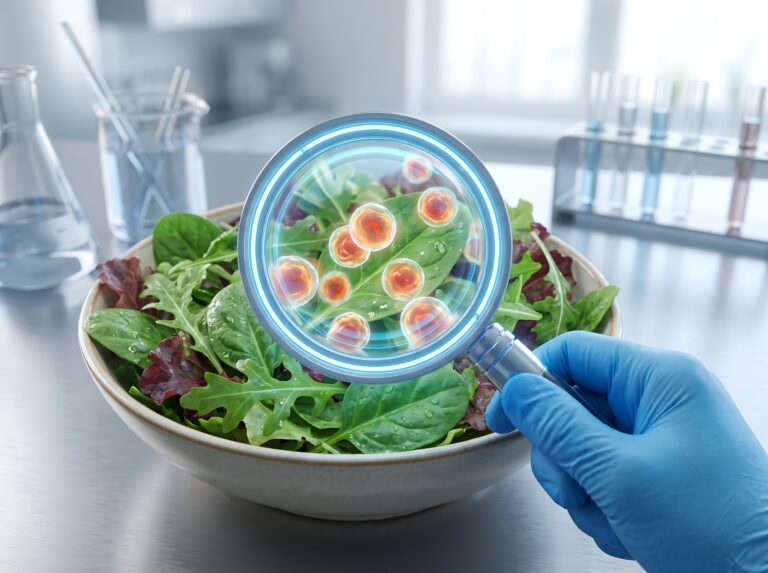
A microscopic parasite called Cyclospora cayetanensis has sickened more than 2,600 people in Michigan this summer, spreading across 55 counties in a state that normally logs 40 to 50 cases in a year, with hundreds of additional cases in neighboring Ohio. State officials suspect lettuce or salad greens but have named no grower, no supplier, not even a specific product. Unfortunately, for Cyclospora outbreaks, this is not an uncommon outcome.
Compared to other foodborne pathogens, C. cayetanensis has an unusual life cycle. An infected person sheds the parasite in a form that cannot yet make anyone sick; rather, the parasite must mature in warm soil or water for one to two weeks before it turns infectious. That is why cyclosporiasis arrives each year with the summer and does not spread from person to person. By the time it moves through the supply chain and reaches a home or restaurant kitchen, it has matured to become infectious. Typical controls used in produce processing such as washing, rinsing and sanitizing have minimal effects; only cooking or extended periods of freezing is effective, and neither is conducted on a bag of salad, fresh herbs, or fruit.
Cyclospora outbreaks are also epidemiologically difficult to investigate. Symptoms can include days or even weeks of watery diarrhea and can take two to 14 days to appear; and testing and reporting take longer still. By the time a health official calls, most infected people struggle to remember a meal eaten three weeks earlier, and the food is long gone. Thus, as reporting on the outbreak has noted, cases are slow to be tallied and depend on patients recalling what they ate weeks before they fell ill.
Whole genome sequencing (WGS) typically used to investigate pathogenic E. coli and Salmonella cases offers little help here. Typically, these genetic investigatory tools can tell epidemiologists whether scattered clusters belong to the same outbreak and can help guide subsequent traceback investigations. But Cyclospora cannot be grown in a laboratory, so a stool sample typically does not yield enough DNA for the WGS that lets scientists match a sick person in one state to a contaminated shipment in another.
Currently, cases are clustered in the Great Lakes, a footprint that may suggest a regionally distributed product rather than a national brand, and more than one outbreak may be running at once. In 2013, two unfolded at the same time: cilantro from one part of Mexico causing an outbreak in Texas, with a salad mix being associated with illness in the Midwest.
Given the lack of preventive controls after product has been grown and harvested, the primary focus for control requires strong on-farm and worker hygiene practices. For those in the food industry, the following points are worth consideration.
Agricultural water represents C. cayetanensis’ most reliable point of entry. Each produce supplier or grower needs to document where its water comes from. Ideally, growers should use protected wells over open surface water wherever the crop and region allow it. Where surface water is unavoidable, appropriate mitigation measures or practices should be implemented, such as drip irrigation in place of overhead spray, properly maintained filtration, and a comprehensive survey of the surrounding watershed for animal farms, septic systems, sewage, and treatment-plant discharge that can reach an intake. The Produce Safety Rule already requires growers to complete an agricultural water assessment, and growers should also have responsive practices following heavy rain or flooding, both of which can push human waste into surface water.
Strong management of worker health and hygiene is also important, because infected people are the only reservoirs the parasite has. The presence of field toilets and handwashing stations that are stocked, working, and sited where crews will use them, along with hygiene training that is conducted, documented, and enforced, all reduce the risk of a worker contaminating produce. Equally important is that handwashing is enforced at every point of product contact, and that a functioning illness reporting and exclusion program is in place. With no kill step available, sanitation at the source is one of the few controls that genuinely reduces risk.
It’s also critical to understand your supply chain well enough to move on a potential signal. When a category like leafy greens or fresh herbs surfaces in an investigation, the suppliers to examine first are those drawing from historically implicated growing regions. A supplier approval program that effectively captures water practices, sanitation, and growing regions lets a buyer narrow their exposure in days.
Given the challenges of investigating a Cyclospora outbreak, improved traceability information can help investigators identify a potential source more quickly. Leafy greens, herbs, and fresh-cut produce all sit on the FDA’s Food Traceability List, and although enforcement of the Food Traceability Rule has been pushed to July 2028, the lot-level records it requires are exactly what an investigator, or an industry recall team, will need when tracing product or initiating a recall. These outbreaks demonstrate the importance of compliance with FSMA 204, and an opportunity to run a mock traceback and time it. If you cannot connect a finished traceability lot code (and traceability lot code source, with all other required key data elements [KDE]) back to a Receiving critical tracking event (CTE) or forward to a Shipping CTE within 24 hours, you are not ready. Decide in advance who speaks for the company and how you will pull product, so that a possible-source or product announcement does not find you improvising.
Assessing that exposure, and closing the gaps it reveals, is what we do at The Acheson Group. Our consultants help growers, processors, and the retail and foodservice buyers who rely on them, evaluate agricultural water and field sanitation programs, stand up supplier verification and FSMA 204 traceability that will hold up under a real investigation, and build the recall and crisis plans that decide how a company fares when an outbreak turns its way. Visit TAG’s infectious Disease Fact Sheets webpage for more information on cyclosporiasis.
COVID Risk Matrix
Influenza
Public Health News
- The Cyclospora outbreak is continuing to expand. See the above article for more information.
- The Ebola outbreak in the Democratic Republic of Congo continues to spread with most of the new cases not being actively detected. Cases have also occurred in Uganda, but there have not been any new cases since June 21. It is believed that the actual case numbers are likely 2 to 4 times higher than the nearly 1,800 that have been reported. It appears that the Bundibugyo strain causing the current outbreak may cause milder symptoms which may lead to more patients being treated at home and inadvertently spreading the virus.
- There have been 56 confirmed cases of Legionnaires’ disease identified in a community cluster in the Upper East Side, New York City. Though the source has not yet been identified, a new policy was put in place requiring immediate full remediation (draining, cleaning, and disinfection) of any cooling tower that tests positive on initial polymerase chain reaction screening. This is a change from the previous protocol, which required increasing chemical disinfectant levels while awaiting confirmatory culture results which could have taken up to two weeks before full cleaning and disinfection were required. Also, under the new policy, building addresses with positive PCR results are now being publicly released.
- The total number of New World Screwworm cases is up to 34, with two more having been reported last week. All the cases are in Texas except one reported in New Mexico.
- A small outbreak of Listeria monocytogenes has been linked to a Chinese buffet restaurant in Florida. The outbreak strain has been detected from environmental samples collected from the restaurant, suggesting a persistent source.