
Although restaurants are implicated in 64% of foodborne illness outbreaks in the U.S. and are generally inspected at least annually (depending on state requirements and risk level), the data acquired from restaurant outbreak investigations and inspections are not commonly assessed in tandem or linked. However, new research has shown that, inspections not only help reduce foodborne illness outbreaks, linking the data from inspections with data from outbreaks can help to inform prevention methods.
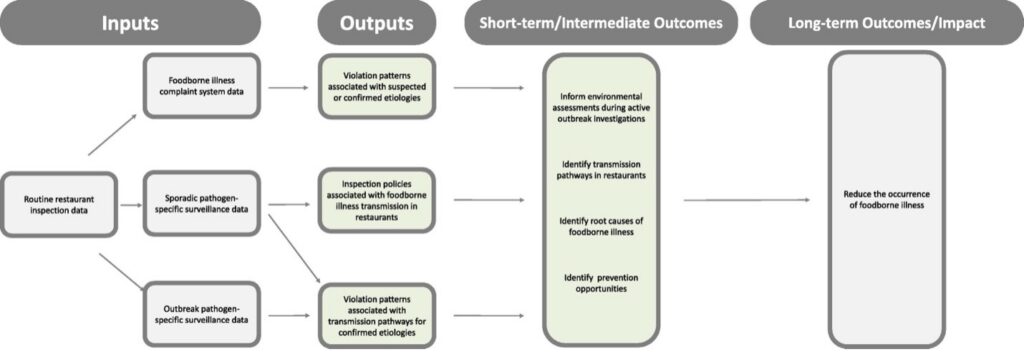
Although the inspections largely focus on compliance, there is evidence that compliance translates to reductions in foodborne illness. For example, the identification of inspection violation patterns can promote understanding of restaurant transmission pathways, enabling the identification of outbreak root causes, the targeting of inspection resources to relevant issues, and the development of novel interventions for prevention. The study’s graphic (below) presents a conceptual framework for the benefits associated with linking routine inspection data to foodborne illness data sources.
The research also showed that model hypothetical scenarios can be developed showing the outcomes if all food establishments had higher or lower scores. This has been shown by studies in Finland and the United Kingdom, which demonstrated the potential public health benefits of improved hygiene measures and the potential public health consequences of less robust hygiene.
The finding is also supported by the implementation of grading systems serving to reduce foodborne illness rates. For example, after New York City enacted a program to publicly post inspection scores at the point of service, not only did inspection scores improve, but the rate of Salmonella infections decreased 5.3% per year in the city compared to the rest of the state, which had not implemented a similar program.
Such outcomes become even more notable when it is seen that the number of restaurant chains that have closed 10% or more of their locations is currently at the highest rate since the pandemic year of 2020. In fact, closures have been on the rise since 2023, with the number of such closures in 2025 nearly doubling those of 2023. While these closures were not necessarily related to inspection issues, there are numerous examples of those that are, with some of the most common restaurant violations being improper food temperatures, cross-contamination, inadequate cleaning/sanitation, poor employee hygiene, pest control lapses, and equipment maintenance failures. Whether any of these would get an establishment shut down, temporarily or permanently, would depend on the severity of the issue(s) along with the restaurant’s history of violations. But whether a violation led to a closure or not, its occurrence can provide data for improvement.
Although this research focused on restaurant inspections, it can be just as attributable to food manufacturing facilities as well as any establishment handling foods. Aligning the data from inspections with that of outbreaks in the same sector can bring to light root causes and corrective measures that were otherwise unseen. Further, if each inspection is seen as a hazard surveillance, each finding can contribute to the larger picture, to inform a framework for reducing the occurrence of foodborne illness and the strengthen global food safety system.
In Summary, new research has shown that restaurant inspections not only help reduce foodborne illness outbreaks, but linking inspection data with outbreak data can also help inform prevention methods. Although the inspections largely focus on compliance, there is evidence that compliance translates to reductions in foodborne illness. This research focused on restaurant inspections, but it can be just as attributable to food manufacturing facilities as well as any establishment handling food.