
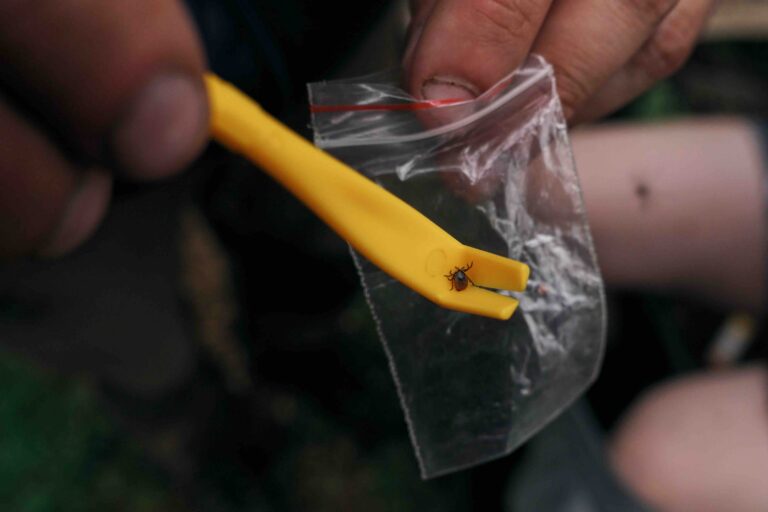
A tick control pilot program, innovation challenges, focused NIH funding, and a public-private collaboration are all part of the HHS’ new multi-million-dollar initiative to combat the tick-borne Lyme disease.
With close to 500,000 Americans diagnosed with Lyme disease each year, it is one of the nation’s fastest-growing vector-borne health threats. And emergency room visits for tick bites, overall, have reached their highest springtime level in nearly a decade.
The HHS combat strategy includes:
- A CDC/HHS collaboration with leading tick-control researchers to develop and deploy practical strategies to target and eliminate ticks on wildlife before they can spread disease to humans. By reducing tick populations and disrupting breeding cycles, the initiative aims to slow disease transmission.
- The National Institutes of Health (NIH) currently invests nearly $50 million annually in Lyme disease research and approximately $122 million annually in broader tick-borne disease research, including efforts focused on prevention, diagnostics, and treatment. This will be expanded with funding for NIH researchers and private sector innovators to combat Alpha-gal syndrome, which at least 500,000 people are currently living with. The participating companies would provide candidate products with NIH conducting the clinical research to evaluate their effectiveness.
- HHS is also offering up to $2.5 million in prize funding for three LymeX innovation challenges to accelerate breakthroughs in public awareness, treatment, and patient care.
- A new public-private collaboration has been established with the International Lyme and Associated Diseases Society (ILADS) at hhs.gov/lyme to connect individuals and families with experienced providers and educational resources related to Lyme disease and associated chronic conditions.
The HHS goal is to reduce Lyme disease cases by 25% by 2035 as compared to 2022 levels.
For more information, visit hhs.gov/lyme and see TAG’s Infectious Disease Fact Sheet on Tick-Borne Diseases.
COVID Risk Matrix:
Influenza:
Public Health News:
- The World Health Organization has determined that the cruise ship-associated Hantavirus outbreak (with 13 cases and 3 deaths) likely occurred from a zoonotic spillover with subsequent human-to-human transmission. Genomic analysis of isolates from the cases has shown genetic relatedness and its use demonstrates the benefits of this tool to track outbreak progression.
- Other hantaviruses cases, not related to the cruise ship outbreak, illustrate the potential for rodent-borne occurrences, including 18 cases reported in Panama in 2025 and the May 2026 death of a 42-year-old male agricultural worker who was likely exposed to infectious particles from rodent feces or urine. There have also been seven cases reported so far in 2026 in Chile, primarily among agricultural workers; and two unrelated cases reported in Colorado in May 2026, one with known rodent exposure.
- The European CDC is reporting that since the beginning of 2026, 68,749 cholera cases, including 944 deaths, have been reported worldwide. New cases reported in May were in Angola, Burundi, Congo, Democratic Republic of The Congo, Malawi, Mozambique, Rwanda, Somalia, South Sudan, and Zambia. These numbers are about 40% lower than reports from the same time period in 2025. https://www.ecdc.europa.eu/sites/default/files/documents/Communicable-disease-threats-report-week-22-2026.pdf