

The Acheson Group continues to share insightful information about public health-related topics to dig deeper into the issues that matter so you can be better educated and empowered to react appropriately. This week’s article is the second of four on the safety and FDA regulatory approval of food and color additives. Following last week’s introductory article, this article focuses on the safety of food color additives, both so-called “natural” and synthetic (aka “artificial”) food colors.
As explained in the first article, color additives have a distinctly separate regulatory pathway for premarket approval from other food additives and are prohibited from being determined as GRAS (generally recognized as safe). Color additives are used in foods for many reasons, including to enhance the natural color of foods, to offset color loss due to environmental factors, to improve natural color variations, and to provide color to colorless foods. FDA regulations mandate that color additives must be proven safe for their intended use, and specify approved foods, maximum levels, and labeling requirements. The FDA has provided detailed information on color additives in foods, including the approval process, certification requirements, labeling, and compliance enforcement, and the third article will delve more deeply into the regulatory oversight of food color additives.
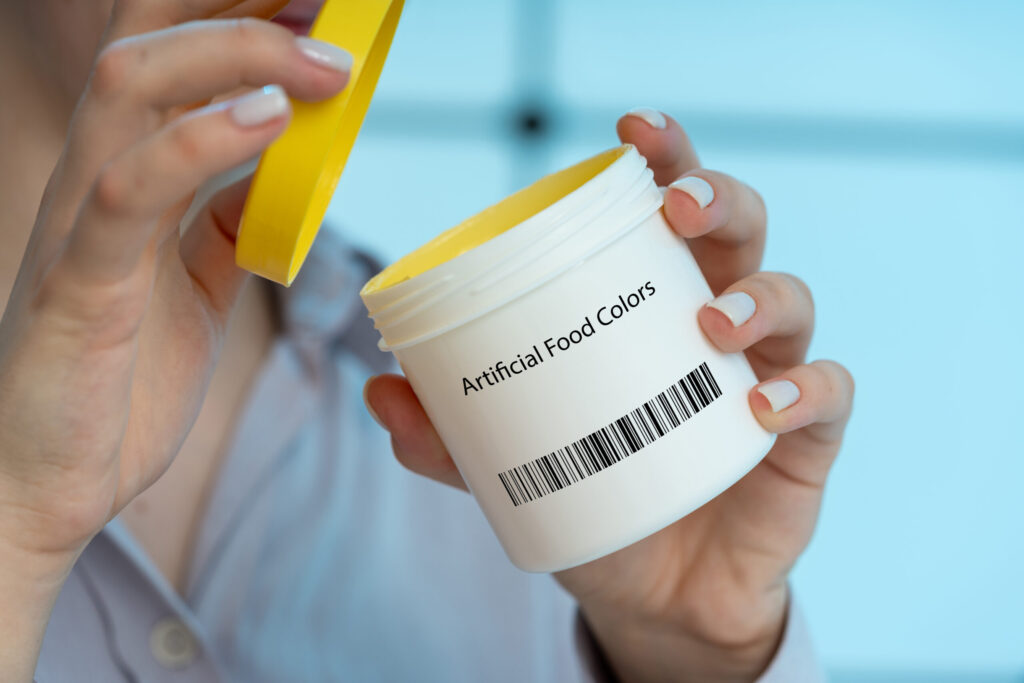
Color additives are divided into two distinct categories: (1) “natural” food colors so called because they are selected, sourced, and prepared from agricultural products like spices, fruits, and produce, and (2) synthetic or “artificial” food colors because they are man-made using organic chemicals that originate from petroleum distillates. These petroleum-derived organic molecules serve as building blocks in the manufacture of synthetic color additives, as they do with many other common products, such as pharmaceuticals (e.g., acetaminophen [Tylenol]), personal care products (e.g., lip balm), and plastic products (e.g., beverage bottles). Synthetic food color manufacturers are required to submit every batch of color to the FDA for testing to ensure it meets purity standards and regulatory specifications before it can be used in food.
The safety of synthetic color additives can hardly be discussed without mentioning the landmark study conducted by researchers at the University of Southampton, UK, on the relationship of synthetic color additives and neurobehavioral effects in children (McCann et al., 2007); however, observational studies regarding diet and ADHD (attention-deficit/hyperactivity disorder) have been occurring for several decades. The study by the UK researchers examined the neurobehavioral effects of mixtures of food colors, of which some are approved for use in the U.S. (Allura Red [FD&C Red No. 40], Tartrazine [Yellow No. 5], and Sunset Yellow [FD&C No. 6]), as well as food color additives not approved in the U.S. (Carmoisine and Ponceau 4R), and the food additive sodium benzoate. Most recently in 2019, the FDA assembled experts to review any links between synthetic food additives and hyperactivity in children. The expert committee found that certain children uniquely react to color and other food additives, but there’s no evidence of inherent neurotoxicity with the colors. They also advised against adding extra warning labels. In addition to reviews by the FDA and other international food authorities, the Joint FAO/WHO Expert Committee on Food Additives (JECFA) and the European Food Safety Authority (EFSA) recently evaluated scientific evidence and found that these food colors were safe for their intended use; however, the EU Commission deemed that a warning requirement was warranted for certain food colors found in the Southampton study and mandated it. Of the six food colors requiring a warning in EU, only three are approved in the U.S., the remainder were never studied in the Southampton or similar studies. A comprehensive scientific review was recently conducted examining the safety of the food colors in the U.S. food supply, which included a review of the neurobehavioral research (Llewellyn, G., et al., 2020). It concluded that published human studies do not offer a strong or reliable causative relationship between food colors exposure and ADHD in children and adolescents.
Beyond neurobehavioral concerns with certain synthetic food dyes, there are a few food colors that have been associated with other potential health concerns. Tartrazine (FD&C Yellow No. 5) is most directly linked to human health concerns due to its association with allergic reactions in susceptible individuals. As such, FDA regulations require food products must bear the following warning statement in addition to the disclosure of Tartrazine as a food ingredient: “This product contains FD&C Yellow No. 5 (tartrazine) which may cause allergic-type reactions (including bronchial asthma) in certain susceptible persons. Although the overall incidence of FD&C Yellow No. 5 (tartrazine) sensitivity in the general population is low, it is frequently seen in patients who also have aspirin hypersensitivity.”
A synthetic color additive that has been the subject of prolonged scientific scrutiny is Erythrosine (FD&C Red No. 3). On January 15, 2025, the FDA issued an order to revoke authorization for its use in foods, which explicitly included a statement that the basis was not food safety but rather on an obscure, technical piece of legislation passed in 1958 called the Delaney Clause. As a result of this law, any substance that causes cancer in laboratory animals and whether it is incapable of doing so in humans, is still banned as a food or color additive. Erythrosine has been found to cause cancer in rats at high doses, but because of a unique hormonal mechanism, there is no evidence of carcinogenicity in other species or humans.
Although not a synthetic, certified food color additive, Titanium Dioxide, a white pigment, has been the object of intense research. Titanium oxide is manufactured from naturally occurring ore, and it’s this process that has created concern about the formation of nanoparticles that potentially could lead to DNA damage (genotoxicity) and possible cancer. Despite the European Food Safety Agency’s (EFSA) opinion in 2021 that titanium oxide was not generally toxic at intended uses, they would not rule out genotoxicity, the FDA and many other country regulatory authorities have disagreed and concluded the studies indicating potential genotoxicity are not relevant to human dietary exposure and still permit its continued use in food as a color additive
FDA scientists regularly review available information about the safety and toxicology of color additives to determine whether the use continues to be safe and compliant under the Federal Food, Drug, and Cosmetic Act. With the level of scientific rigor that FDA includes in the robust approval and maintenance processes for food and color additives, industry and consumers can be assured of their safety and use them confidently.
The third article in this four-part series will cover FDA regulation of food color additives.
Infectious Disease News:
- In the US, measles cases have hit the highest total since the disease was eliminated from the country in 2000, with 1,288 cases reported as of July 8, 2025. Since then, at least 6 additional cases have been reported in Kansas, New Jersey, and North Dakota.
- Tick bites have also reached their highest levels in the US since 2017, with the Northeast reporting the highest number of related ER visits, with 229 tick bit issues out of 100,000 visits.
- A human death from pneumonic plague in Flagstaff, Arizona has been reported. It was suggested that this case could have been related to recent prairie dog die-off, but health officials have refuted this. Plague is a very rare disease in humans though it occurs naturally in areas of the western US, where it circulates among wild rodents and other animals. Health officials are investigating to determine the source of the human case.
- CDC has ended its emergency response to H5N1 bird flu due to the drop in the number of cases, and it is streamlining its communications by moving to monthly reporting of cases in humans. Future reporting of HPAI cases in animals will now come from the USDA.
- The European Food Safety Authority has published its monthly report on the surveillance of West Nile virus infections in humans and animals in Europe. Through July 2, 2025, no human cases have been reported and there are a lower number of outbreaks in birds and horses compared to last year, suggesting lower levels of viral circulation in the environment.